
1300 Hospital Dr #220
Mount Pleasant, SC 29464
Mount Pleasant, SC 29464
Effective. Proven. Trusted.
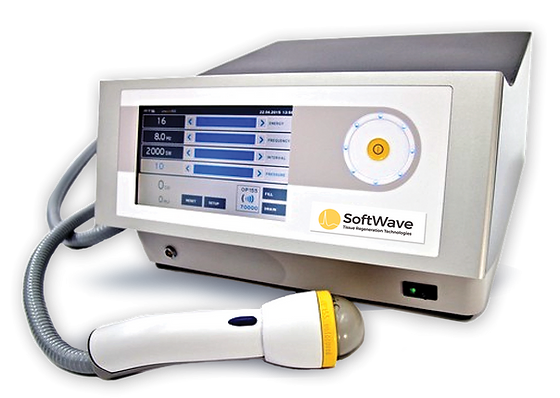
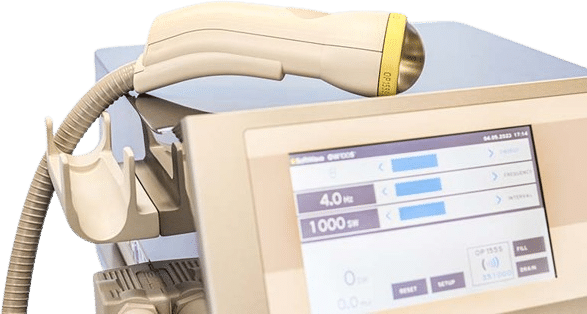
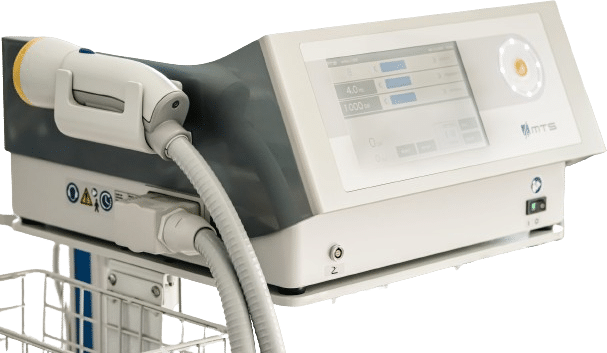
Struggling with Knee or Shoulder Pain that won't improve?
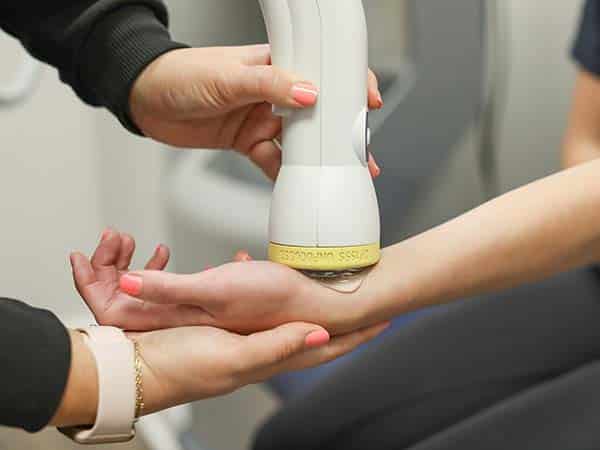
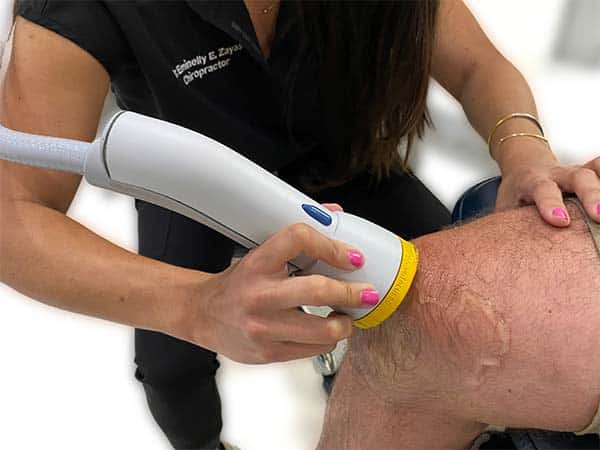
From serious sports injuries causing tissue damage to bone issues and stiffness that comes with age, living with pain is, well, a pain. But it's more than that - it's a stressful, often upsetting way to get through your day, month, and year. Have you ever tried to get out of bed with sore, stiff knees? Most folks would rather just get back in bed. Think you might try exercising with plantar fasciitis? Don't plan on running far or doing cardio for very long. Torn rotator cuff? Without proper treatment, your life might not ever be the same.
Living with pain and the inevitable issues that come with age can seriously affect your wellbeing and happiness. Sure, you could wake up every morning and rely on addicting medications to help you move. Or, you could risk further injury and damage with invasive surgeries that require long periods of recovery and downtime. But those can't be the only two options for treatment, can they?
Fortunately, a new, natural, non-invasive treatment for pain is revolutionizing the medical industry and transforming people's lives. It's giving athletes, average folks, and people of a certain age a reason to be hopeful. It's called Softwave therapy, and unlike many fly-by-night medications and sketchy treatments, it's backed by science and provided by Elite Healthcare Physical Medicine.
If you're barely making it through the day suffering from chronic pain, this FDA-approved drug-free treatment may be for you. Softwave therapy has already been used by thousands of people around the country living with issues like shoulder pain, knee pain, and plantar fasciitis. You could be next.
Though its popularity has only grown in recent years, Softwave therapy - also known as shockwave therapy - has been around for years. In fact, the first systematic study into the benefits of shockwave therapy took place way back in 1950. So, what is Softwave therapy?
Softwave therapy is a method of treatment that works incredibly well for mobility rehab, pain relief, and full-body recovery, usually from chronic pain or injuries. Softwave therapy uses a device emitting low-energy soundwaves that target a patient's injured area. These low-intensity waves boost blood flow and kickstart your body's natural healing processes, relieving long-term pain and helping your body to heal a wide range of injuries and conditions.
The main targets in the body include bones, tendons, and other soft tissues, which are encouraged to regenerate and repair via the shockwaves. Often, shockwave therapy is used in conjunction with other non-invasive treatments like chiropractic care, which we offer at Elite Healthcare Physical Medicine. The results are often incredible, leaving patients wondering why they never tried Softwave therapy before.
Softwave therapy works especially well for:

Better Blood Flow

Collagen Stimulation

Reducing Inflammation

Kickstarting cell growth and healing factors

Breaking down build-ups of calcium
With FDA clearance, little-to-no side effects, and quick application time, Softwave therapy is a welcome alternative for people suffering from pain. Who wants to spend weeks or months recovering from a surgery that might not even work? Likewise, who would want to become dependent on over-the-counter or, even worse, prescription pain meds? Living a life of addiction is a road nobody wants to go down.
Softwave therapy represents a revolution in non-invasive pain treatment; best of all, it's highly effective. Independent studies prove that shockwave therapy helps with pain. 65-91% of patients using shockwave therapy experienced real-deal improvements in damaged muscle and bone tissue, solving their mobility problems and drastically reducing pain. It almost sounds too good to be true, but as many patients at Elite Healthcare Physical Medicine will tell you - it isn't.
Book AppointmentSome of the most common conditions that Softwave therapy treats include:








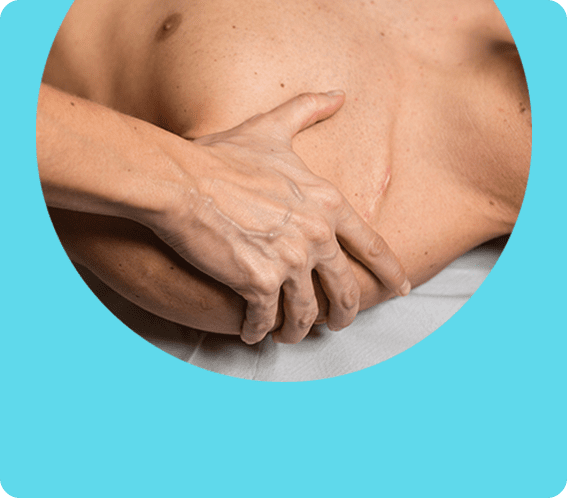
When you get up in the morning and go to the bathroom to brush your teeth, do you notice a stabbing, sharp pain near your heel? Does the pain go away once you have a chance to walk around? If so, you could have plantar fasciitis. According to the American College of Foot and Ankle Surgeons, this painful condition is quite common. About two million people suffer from plantar fasciitis every year, and almost 10% of all people will experience the condition at least once in their life.
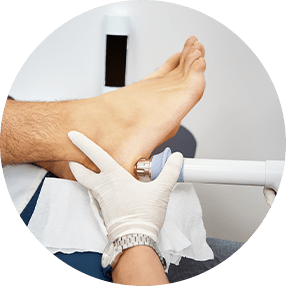

This common foot issue happens when the plantar fascia - a fan-shaped tissue near your heel - gets inflamed. The plantar fascia is a thick strip of connective tissue that links your toes to your heel bone, helping to preserve the arch of your foot. When this band is strained, it causes intensely sharp pain, usually in the morning when you wake up and plant your feet on the floor.
Most folks ignore plantar fasciitis because the pain eventually goes away throughout the day. However, if left untreated, plantar fasciitis can lead to weakness and chronic pain, which may affect daily walking.
Some causes of plantar fasciitis include:
The short answer to this question is not really. Patients with plantar fasciitis will ice the affected area with little-to-no relief since they spend so much time on their feet. It's hard to rest an achy heel if you've got a job that requires you to be on your feet. Anti-inflammatory meds like Advil don't work all that well, either. They may provide temporary pain relief, but in terms of a long-term solution, taking these drugs will cause major side effects.
Book Appointment
When more conservative treatment options like ice and over-the-counter meds don't work, most doctors turn to ultra-expensive orthotics, steroid injections, or invasive surgery. For the average person, those options fail on all fronts, as they carry risks for side effects and may even cause the issue to worsen.
Instead of going under the knife or changing their daily routines, many people suffering from plantar fasciitis are turning to Softwave therapy for relief.
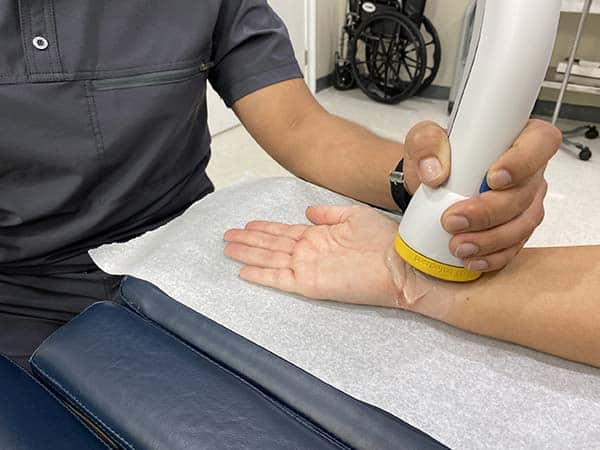
During a shockwave therapy session, our expert providers use a special probe to deliver pressure waves to inflamed tissue. These waves trigger natural healing processes causing new blood vessels to form. In turn, oxygen is supplied to the affected area, reducing inflammation and causing healthy cells to regenerate. Shockwave therapy also produces collagen, which is crucial for connective tissue health.
With just a few visits, many patients find long-term relief from plantar fasciitis without relying on strange drugs or harmful surgeries.
Living with knee pain is just miserable. From knee tendonitis to osteoarthritis, knee pain can prevent you from enjoying activities and affect your day-to-day life. Your knee is a joint comprised of cartilage, bone, ligaments, and fluids. Tendons and muscles within the knee help the joint move. When one of these crucial knee structures is hurt or compromised, it results in knee pain and long-lasting knee problems. This, in turn, leads to difficulty walking at best and debilitating knee issues at worse.
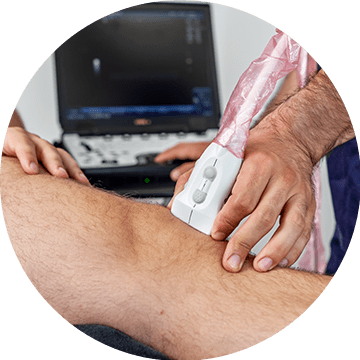

If you're an active person or somebody who plays sports often, you're probably all too familiar with knee pain - especially common conditions like patellar tendinopathy. Also called "jumpers knee," this issue happens at the patellar tendon, which is found on the front of the knee just under the knee cap. When living with this condition, most patients experience pain around the kneecap or lower down on the leg around the tibia.
In addition to injuries and issues like jumper's knee, everyday wear and tear will cause knee pain over time. With time, this knee pain can develop into arthritis. If your knees are swollen, painful, or stiff, you may have arthritis in your knees. Regardless of the kind of knee pain you're experiencing, treatment options have been limited to agonizing surgeries and addicting pain medications. But that all changes with shockwave therapy for knee pain in Awendaw, SC.
Though no two knee pain problems are exactly the same, shockwave therapy has been shown to be highly effective for knee pain. In fact, many patients at Elite Healthcare Physical Medicine find relief after just one session. Many times, sessions can be completed in as little as 30 minutes. So if you want to find relief for knee pain on your lunch break, that's definitely possible.
As is the case with plantar fasciitis, Softwave therapy works by sending sound wave and low-energy impulses to the affected area of your knee. These pulses stimulate your body's healing factors, which can help regenerate and repair damaged tendons and tissues. Softwave therapy for knee pain is especially promising for people who have tried other treatments - like surgery and pain meds - with disappointing results.
Benefits include:
Several studies and reviews prove that Softwave therapy can be very beneficial for people suffering from knee pain problems like jumper's knee. A study involving 66 patients with knee pain found that they enjoyed a significant improvement in their reported pain levels with Softwave therapy. In fact, knee pain was reduced by nearly 50% after a single month. When combined with other regenerative and physical therapy treatments at Elite Healthcare Physical Medicine, your days of living with knee pain are numbered.
Book AppointmentHere's a fact for you to consider: Every joint that you have in your body plays a part in your day-to-day life. But when we think of joint issues, we typically jump to knee issues. However, your knees aren't the only joints in your body to go through wear and tear. Your shoulders experience just as much, if not more, wear and tear than your knees. We put a strain on our shoulders just about every time we use or move our arms. Our shoulders play a pivotal part in living a normal life. When they begin to deteriorate over time due to age or overuse, it creates a litany of painful problems.
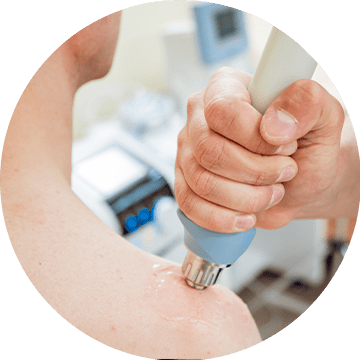

There are many causes of shoulder pain, like deterioration, inflammation, and trauma. Of the many painful shoulder conditions affecting Americans yearly, rotator cuff tendonitis and arthritis are very common. Also called calcific tendinitis, rotator cuff pain is caused by built-up calcium deposits on the shoulder's tendons, which connect your rotator cuff to nearby muscles and bones. This painful condition is usually linked to sports, like basketball and volleyball, or in professions requiring repetitive movements, like in the plumbing industry.
Some common symptoms of shoulder pain and rotator cuff tendinitis include:
Though strengthening exercises and some medications provide temporary relief for shoulder pain, they're not meant as long-term solutions. Luckily, Softwave therapy for rotator cuff pain in Awendaw, SC, can help.

Shockwave therapy has been shown to work wonders for shoulder pain. Low-intensity shockwaves break up calcium deposits and jumpstart your body's healing processes, stimulating blood flow and healthy cell growth. Shockwave treatment is especially effective for long-term shoulder pain since it releases stem cells, sends growth factors to the affected area, and boosts capillary production. Shockwave therapy has also been shown to break down scar tissue and eliminate trigger points, all of which decrease shoulder pain. This relief is most often long-lasting, unlike other treatments like medications and injections.
Many studies support the efficacy of Softwave therapy for shoulder conditions like rotator cuff pain and calcific tendonitis of the shoulder. In a study of 84 patients living with long-term rotator cuff tendonitis, participants in the treatment group saw a significant decrease in the intensity of their shoulder pain. Another study related to shockwave therapy for calcific tendonitis found that 86.6% of patients experienced fewer calcifications.
If you're having to live with rotator cuff pain or another type of shoulder issue, choosing Softwave therapy may be your best course of action.
Book AppointmentWhether you're sick of living with intense heel pain from plantar fasciitis, the mobility issues associated with knee pain, or the day-to-day struggles of rotator cuff degeneration, you'll find hope at Elite Healthcare Physical Medicine. Unlike some medical clinics, our team of doctors and specialists focus on an integrative, multidisciplinary approach to healing. Instead of relying on addictive medications and invasive surgeries, we prefer to address the underlying causes that our patients face.
We combine several all-natural pain relief therapies so that your shoulder pain, knee pain, joint pain, and foot pain go away for good. We resolve pain by using healing treatments that restore function and improve mobility for the long term. Our state-of-the-art regenerative medicine treatments, used hand-in-hand with proven chiropractic techniques, will stimulate your body's healing power from within. If your pain is related to muscles, nerves, and bones, our doctors can help you overcome discomfort, injury, or medical conditions affecting these systems.
If you've been unable to resolve your pain or have become dependent on painkillers to cope, Softwave therapy may be the natural solution you need. It all starts with a quick call to our office, so we can begin to understand your needs. When you come for your first visit, our doctors will find the personalized treatment you need so that you can manage your pain in a non-invasive and drug-free environment manner.
Book AppointmentAWENDAW, S.C. (WCSC) - Some homeowners in Awendaw say they are concerned severe weather may be bringing severe problems to their properties.Community members living on Seewee Road claim more recent storms in the Lowcountry have caused drainage issues for roadside ditches along the six-mile stretch of rural road.“My backyard is just totally covered with water,” neighbor Stephen Flagg says. “My front yard has been totally covered with water. I mean, something just needs to be done.”Flagg lives on th...
AWENDAW, S.C. (WCSC) - Some homeowners in Awendaw say they are concerned severe weather may be bringing severe problems to their properties.
Community members living on Seewee Road claim more recent storms in the Lowcountry have caused drainage issues for roadside ditches along the six-mile stretch of rural road.
“My backyard is just totally covered with water,” neighbor Stephen Flagg says. “My front yard has been totally covered with water. I mean, something just needs to be done.”
Flagg lives on the same portion of land as his grandmother, Lillie Swinton. The family has called Seewee Road home since the 1960s. They say they have noticed the problem for decades.
Both Swinton and Flagg say taking care of the ditches along the property is one thing, but they believe fixing the ditches along the wooded areas and uninhabited spaces would make a big difference.
“Anytime we have heavy rain, the water settles. The ditch drain, there’s nowhere for it to go,” Swinton says. “When summer comes, we’re going to have a lot of trouble with mosquitos, and moccasin snakes.”
At one end of Seewee Road sits the Town of Awendaw Town Hall. Town Administrator Gregory Saxton says he has heard the concerns of neighbors and relayed them to the South Carolina Department of Transportation for assistance.
Seewee Road is a state road and therefore maintained by SCDOT through work orders.
“We just want something to be done. Because after all, we’re taxpayers, just like others. We should be able to have access to things, just like the other communities,” homeowner Alberta Goodwine says. “When it’s raining, the water just settles into the ditches and overflows in the yard. It’s a nuisance.”
Goodwine worries parts of the neighborhood community have been neglected. She adds it is a problem that affects her social life and her daily routines.
“When I step out, I’ve gotta have a boot on coming off the step. To protect myself,” Goodwine says. “Put pipes or something, so drainage will go somewhere, not on my property.”
SCDOT spokesperson Ginny Jones released the following statement:
We had a crew work on ditches along Seewee Road Jan. 2-5. Last week, the crew had to work on storm recovery efforts, but we have employees back out there today. The crew will not be onsite tomorrow due to a regularly scheduled safety meeting, but they will return on Thursday and Friday, as well as next week if necessary. Our crews are digging along approximately 9,100 linear feet of roadway, so it is taking some time, but we will continue to work on it as needed.
Regarding a work order, the answer is both: A citizen may enter an online work request, or a municipality may enter a work request on behalf of a citizen. Online work requests can be submitted here: https://apps.scdot.org/mwro/
We have been in touch with the Town of Awendaw about this work. Please let us know if you need any further information.”
When asked for clarification on how uninhabited portions of the road are maintained, Jones released this response:
SCDOT maintains what is in our right of way. If the land belongs to a municipality, county, or other party, we often work with those folks to plan for maintenance, but there are a lot of different ways that can look.
Copyright 2024 WCSC. All rights reserved.
AWENDAW, SC (WCIV) — For weeks, Awendaw residents have been expressing concerns about the potential of hundreds of new homes coming to their community."Town council has approved 822 new residences with more on the docket tonight," Awendaw resident John Cooke said. "Those residences come with a population that will at least double our current population."Read more: ...
AWENDAW, SC (WCIV) — For weeks, Awendaw residents have been expressing concerns about the potential of hundreds of new homes coming to their community.
"Town council has approved 822 new residences with more on the docket tonight," Awendaw resident John Cooke said. "Those residences come with a population that will at least double our current population."
Read more: Awendaw residents fear housing boom could threaten town's rural charm
However, Mayor Miriam Green says the population will not be doubled.
"It's not the truth," Green said. "It's not a total of 800 homes. And if it is, they still have to go through planning."
"I can't say it's 800, 9,00, or 1,000 homes because I don't know," she continued. "But in the preliminary plan, yes, it did say certain amount of homes will be built up there."
Green describes the development plans as "smart growth".
"We are following ordinance and processes of procedures and state guidelines," she said.
In response to the concerns about the development plans being too much in too little time, Green says the town has to follow guidelines and the rules.
"Just because someone comes to you and says 'This is what we want,' doesn't meant that's what the majority of the citizens of Awendaw want," the mayor said.
Residents have also expressed concerns about how new developments may affect Awendaw's roads and infrastructure.
Read more: Ten Mile Neighborhood Association challenges proposed approval of development along Seafood Road
"Last meeting, I heard emergency services people talk about the fact that they were concerned about their ability to support the town," Cooke said. "The roads, the infrastructure might not be able to support (new development). The roads that were made in the early 1950s-60s are still the ones being used today and could fail."
Green says the infrastructure, road, and traffic issues are being analyzed as part of the development plans.
"We're looking at all that stuff," the mayor said. "We have a traffic study in place, but it doesn't happen overnight."
Another concern is the septic tanks that will be used for the new development, which Green says the town is working on with the South Carolina Department of Health and Environmental Control (DHEC).
Read more: Zoning denial a 'win' for some Awendaw residents
"20 years when all these systems start to fail, you could have an ecological disaster that could affect a lot of bulls bay and the intercoastal waterways," Cooke said.
The evening of Aug. 21, the Awendaw Planning Commission reviewed the Harper Valley proposal. It was denied in a 5-1 vote.
Cooke says people who live in Awendaw are banding together in opposition and they are asking for a moratorium to slow down the development.
"It's a growing pain in Awendaw," Green said. "It's not the people that live here. It's the people that came here."
It's more important than ever that town officials recognize the growing importance and intensity of their planning work — and rise to the occasion to protect the relaxed, rural ambiance that has defined this part of South Carolina's coast.There are some encouraging signs.A year ago, we lamented proposals to develop two large subdivisions, with 249 and 204 homes respectively, to be served by individual septic tanks since there are no sewer lines in the town. Those are still in the permitting stages and we hope they will be...
It's more important than ever that town officials recognize the growing importance and intensity of their planning work — and rise to the occasion to protect the relaxed, rural ambiance that has defined this part of South Carolina's coast.
There are some encouraging signs.
A year ago, we lamented proposals to develop two large subdivisions, with 249 and 204 homes respectively, to be served by individual septic tanks since there are no sewer lines in the town. Those are still in the permitting stages and we hope they will be scaled back if they're built at all. They certainly underscore the need for state regulators to consider the cumulative impact of large subdivisions with dozens, even hundreds, of septic tanks that can compromise nearby waterways, as they have done along Shem and James Island creeks.
But the encouraging news is when yet another septic-tank subdivision was proposed recently, the Awendaw Planning Commission voted unanimously against Sewee Landing's 72 homes on 50 acres. At the same meeting, the commission recommended an update of the town's planned development ordinance that these subdivisions had relied on.
Awendaw Town Council could consider both the subdivision proposal and the ordinance rewrite as early as this week, and we urge council members to follow their planning commissioners' advice.
Even when a septic system is well-maintained, it can face problems if the water table is too high, and rising groundwater can carry the resulting contaminants to rivers and marshes, a problem that's expected to grow more acute as climate change pushes sea levels higher. Awendaw's proximity to the pristine Cape Romain makes it a desirable place to live, but too many septic tanks too close to the refuge (and too close to each other) could taint the very thing that makes the area an attractive place to visit and to live.
These developments don't pose a threat simply because they would rely on septic systems. They also would increase the amount of impervious surface and stormwater runoff, exacerbate habitat loss and degrade the community's rural character.
Awendaw is a small town that seems to have been pushed around at times. Its deal for a new park to be created by then-Charleston County Councilman Elliott Summey in exchange for Mr. Summey's right to mine dirt on the park site ended badly. The mining stopped in 2019, but the town had to sue to try to get an accounting of what was done there; the park itself is still a distant dream. In another part of town, the King Tract mine was allowed to expand even though it had been hit with more than a dozen water quality violations.
So we're encouraged that there's a proactive solution in the works. Awendaw is drafting a new comprehensive plan to replace one that's 13 years old. This process will provide town leaders, residents and others a perfect chance to forge a shared vision of how the town should manage growth, and they should make sure they make the most of this chance.
After all, the pressures on their town are only expected to intensify in the years to come.
Click here for more opinion content from The Post and Courier.
AWENDAW, S.C. (WCBD) -A proposed development, the White Tract Development, in Awendaw has some neighbors calling for a time-out.Pulte Homes, one of the nation’s largest homebuilders, is seeking the Town of Awendaw’s approval to build a 200+ home subdivision on approximately 148 acres. The planned location is just down the street from the intersection of Seewee and Bulls Island Roads.Some neighbors say they’re worried a large subdivision could cause future problems for the area.“If you go down Bull...
AWENDAW, S.C. (WCBD) -A proposed development, the White Tract Development, in Awendaw has some neighbors calling for a time-out.
Pulte Homes, one of the nation’s largest homebuilders, is seeking the Town of Awendaw’s approval to build a 200+ home subdivision on approximately 148 acres. The planned location is just down the street from the intersection of Seewee and Bulls Island Roads.
Some neighbors say they’re worried a large subdivision could cause future problems for the area.
“If you go down Bulls Island Road right now, it’s very peaceful and tranquil…a pretty little country scene.,” said Greg St. Pierre, an Awendaw resident. “They’re gonna exploit every bit of that.”
St. Pierre and his neighbors understand growth is inevitable, but they’re hopeful Awendaw leaders will do it in what they call “the right way.” St. Pierre says there should be proactive plans for stormwater drainage, traffic mitigation, improved roadways, and more before the neighborhood is built. Additionally, the proposed spot is close to a National Wildlife Refuge and neighbors say it could be harmful to the species that thrive there.
On top of that, he says residents weren’t informed about the possible development until very recently and are now being asked to voice their opinions in a public hearing next week.
“Basically, the people are just asking for a little bit more time to understand what’s happening here.”
“You can’t stop people from selling their land, you can’t stop development from happening. It’s gonna happen, but do the right thing and don’t cram a bunch of cookie-cutter houses on postage-stamp-sized lots,” said St. Pierre.
Another concern by St. Pierre is the town’s lack of a full-time planning director. Currently, the town only has a part-time interim planning director in-house four hours per week.
News 2 contacted the Town of Awendaw with some of the questions posed by St. Pierre. The questions and answers are below.
Q: Are you aware of the concerns of Awendaw residents about the potential White Tract development? If so, what is your response?
A: The Town is aware of the concerns about the White Tract development. The White Tract Development is being developed under the auspices of a Planned Development adopted by Town Council in 2006. The approval of that Planned Development document also raised many of the concerns the Town is hearing today. A Planned Development is utilized in order to allow the Town to allow flexibility in development that will result in improved design, character, and quality of new developments and preserve natural and scenic features of open spaces. The Town of Awendaw provides for the establishment of planned development districts as amendments to a locally adopted zoning ordinance and official zoning map. The adopted Planned Development map is the zoning district map for the property. The planned development provisions must encourage innovative site planning within planned development districts. Planned development districts may provide for variations from other ordinances and the regulations of other established zoning districts concerning use, setbacks, lot size, density, bulk, and other requirements to accommodate flexibility in the arrangement of uses for the general purpose of promoting and protecting the public health, safety, and general welfare.
Q: We are hearing concerns about infrastructure surrounding the area (roads, water drainage, etc.) should a subdivision be built in the listed area. Does the town have proactive plans to address possible future problems (deteriorating roads, a lack of turning lanes leading to traffic safety concerns, water drainage) as a result of a large neighborhood?
In collaboration with the County of Charleston, the Army Corps of Engineers, DHEC and other jurisdictions, the Town is assured that roadways, stormwater drainage and traffic concerns are addressed. The Town may request additional plans and specifications of the developer of the land should they feel that something might need to mitigated in an appropriate fashion. The applicant has submitted plans to subdivide the three parcels of approximate 148 acres in to 204 parcels.
Q: I understand the Town of Awendaw only has a part-time (4 hours per week) Planning Director. Can the town handle a development of this size?
A: This is correct. The BCDCOG is contracting with the Town to provide an experienced Planning Director on an Interim basis. The Director is on-site at Town Hall for 4 hours per week, however, the Director spends upwards of 10-16 hours per week on Awendaw business. The past Town Administrator, Bill Wallace, is also actively working part-time for the Town and has over 4 decades of urban planning experience. Between the two individuals, the Town feels we have more than adequate experience to handle this project.
“If we can’t stop the neighborhood, we’re going to try to push for more green spaces, road improvements, anything that’s gonna help in the community,” said St. Pierre.
A public hearing is set for March 21st at 6 p.m. at Awendaw Town Hall for residents to share their opinions on the proposed development. St. Pierre says many people plan to come out and voice their concerns in hopes that the application for development will be denied.
CHARLESTON COUNTY, S.C. (WCBD) – A recent land purchase by the Charleston County School District (CCSD) could be the home of a joint middle and high school that would cater to students in Awendaw, McClellanville, and, possibly, Mt. Pleasant.The $3.5 million, 107-acre property is located about 17 miles north of Wando High School off Highway 17 near Jenkins Hill Road.It was purchased with the idea of building a school, but that process is just beginning.“We’re investing in the future and also creating a s...
CHARLESTON COUNTY, S.C. (WCBD) – A recent land purchase by the Charleston County School District (CCSD) could be the home of a joint middle and high school that would cater to students in Awendaw, McClellanville, and, possibly, Mt. Pleasant.
The $3.5 million, 107-acre property is located about 17 miles north of Wando High School off Highway 17 near Jenkins Hill Road.
It was purchased with the idea of building a school, but that process is just beginning.
“We’re investing in the future and also creating a situation where we hope to have a community school for that area,” said Jeff Borowy, the Chief Operating Officer for CCSD.
On Wednesday, District 2 Constituent Board members, parents, and community members will learn more details about what programs the school could provide, attendance numbers needed to make it come to life, and more.
“We’re going to get a little more definition about some of the programs that it potentially could offer. What we do know, at least what we’ve been told before, is that the school will probably have a population of 1,000 children and it will be a middle school/high school,” said Pamela Jouan-Goldman, the chair of the District 2 Constituent Board.
Many parents in the area say this school is a long time coming.
In 2016, CCSD permanently closed Lincoln Middle-High School due to low attendance numbers. Since then, elementary and middle school students attend St. James-Santee Elementary-Middle School, and high school students attend Mt. Pleasant high schools including Wando High and Oceanside Collegiate Academy (OCA).
“I’d say its about 25 to 30 miles each way,” said Nida Singleton.
Singleton lives in McClellanville and takes care of her nephew who attends OCA. Fortunately, his schedule is adjusted to begin the school day at 11:30 a.m., but when he attended Laing Middle School last year, the early mornings and long drives took their toll.
Singleton still drives to drop him off and pick him up each day.
“Getting up early, getting home late, still having activities and homework and all that, and it’s just a lot coming from McClellanville.”
She works two jobs and had to adjust her schedule to accommodate for travel to and from school. She says she’s hopeful the proposed school will come to fruition.
“I wish my nephew of my future kids could go to something closer.”
One concern with the feasibility of the school is attendance. In order to make it happen, around 1,000 students would need to be enrolled. Borowy says the target is 500 each for both the middle and high schools.
As it stands now, the likelihood of just the Awendaw and McClellanville areas meeting those requirements is slim due to the population in those areas. However, there’s a possibility that some students could come from Mt. Pleasant.
“It will be extremely difficult to create a zoning situation where we’ll be able to capture 500 students in either of the school schools without progressing very far south into Mt. Pleasant,” said Borowy.
He says that possibility will be discussed over the coming months with District 1 and District 2 constituent boards.
Another option being looked at is offering a magnet program at the school. That would allow students from all over to attend the school to supplement attendance numbers.
For now, basic details are being presented and more information, as well as public feedback meetings, will be offered in the future.
 (843) 936-6238